
Issued certificate request alerts send email notifications when a certificate request has been approved and the certificate has been issued. Notifications can be sent to the original requester and/or other relevant parties, and can be customized to include detailed certificate information.
Alerts → Issued Request
The issued alert handler runs immediately when an enrollment Certificate enrollment refers to the process by which a user requests a digital certificate. The user must submit the request to a certificate authority (CA). is approved within the Keyfactor Command platform and also runs via a schedule to pick up any approvals done outside of Keyfactor Command. Issued alerts use the pending certificate request alerts schedule for any jobs that run on a schedule (see Configuring a Pending Request Alert Schedule). Certificate requests approved externally must first be synchronized into Keyfactor Command using a CA A certificate authority (CA) is an entity that issues digital certificates. Within Keyfactor Command, a CA may be a Microsoft CA or a Keyfactor gateway to a cloud-based or remote CA. synchronization job before they will be picked up by a scheduled issued alert job.
A workflow is a series of steps necessary to complete a process. In Keyfactor Command, it refers to the workflow builder, which allows you to automate event-driven tasks such as when a certificate is requested, revoked or found in a certificate store. step following the enrollment step in an enrollment workflow (see Add, Copy, or Modify a Workflow Definition).Because scheduled alerts process previously approved requests that have been synchronized into Keyfactor Commandv (specifically those that required CA manager approval), configuring issued alerts after initial CA synchronization is recommended. This helps prevent a large volume of alert emails from being generated for existing approved requests.
Add or Modify an Issued Request Alert
- On the Issued Certificate Request Alerts page, choose Add from the toolbar to create a new alert, or select an existing alert and choose Edit from the toolbar or right-click menu.
-
In the Issued Certificate Alert Settings dialog, select your Certificate Template (or select All Templates) in the first dropdown.
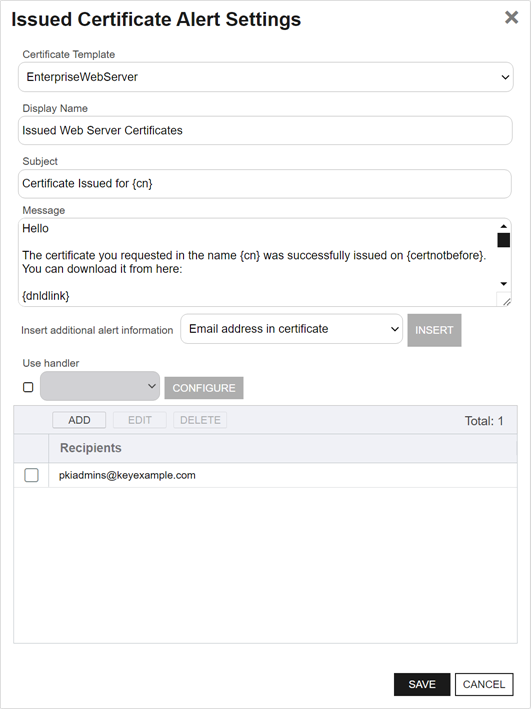
Figure 179: Create a New Issued Certificate Alert
- In the Display Name field, enter a name for the alert. This name appears in the list of issued certificate alerts in the Management Portal.
-
In the Subject field, enter a subject line for the email message that will be delivered when the alert is triggered. You can use substitutable special text in the subject line. Substitutable special text uses a variable in the alert definition that is replaced by data from the certificate or certificate metadata
Metadata provides information about a piece of data. It is used to summarize basic information about data, which can make working with the data easier. In Keyfactor Command, the certificate metadata feature allows you to create custom metadata fields that allow you to tag certificates with tracking information about certificates. at processing time. For example, you can enter {cn A common name (CN) is the component of a distinguished name (DN) that represents the primary name of the object. The value varies depending on the type of object. For a user object, this would be the user's name (for example CN=John Smith). For SSL certificates, the CN is typically the fully qualified domain name (FQDN) of the host where the SSL certificate will reside (for example servername.keyexample.com or www.keyexample.com).} in the alert definition and each alert generated will contain the specific common name A common name (CN) is the component of a distinguished name (DN) that represents the primary name of the object. The value varies depending on the type of object. For a user object, this would be the user's name (for example CN=John Smith). For SSL certificates, the CN is typically the fully qualified domain name (FQDN) of the host where the SSL certificate will reside (for example servername.keyexample.com or www.keyexample.com). of the given certificate instead of the variable {cn}.To add substitutable special text to the subject line, place your cursor where you would like the text to appear on the subject line, select the appropriate variable from the Insert special text dropdown, and click Insert. Alternately, type the special text variable enclosed in curly braces (for example, {cn}).
-
In the Message box, enter the body of the email message that will be delivered when the alert is triggered. You can use the Insert special text dropdown below the message window to add substitutable special text to the message. The metadata that appears in the dropdown will depend upon the custom metadata you have defined (see Certificate Metadata). Place your cursor where you would like the text to appear, select the appropriate variable from the dropdown, and click Insert. Alternately, you can type the special text variable enclosed in curly braces directly.
CopySerial Number: {serial}
Thumbprint: {thumbprint}
SANs: {san}
App Owner: {metadata:AppOwnerFirstName} {metadata:AppOwnerLastName}With this HTML code:
Copy<table>
<tr><td>Serial Number: </td><td>{serial}</td></tr>
<tr><td>Thumbprint: </td><td>{thumbprint}</td></tr>
<tr><td>SANs: </td><td>{san}</td></tr>
<tr><td>App Owner: </td><td>{metadata:AppOwnerFirstName} {metadata:AppOwnerLastName}</td></tr>
</table>Note: When using HTML to format an email sent from Keyfactor Command, use inline styles and avoid linked stylesheets or embedded <style> rules. Many email clients do not fully support external or embedded CSS.Line breaks are not inserted automatically when HTML formatting is used. Define line breaks explicitly using tags such as <br>, <br/>, or <p></p>.
Recommended:
<p style="font-size:14px; color:#333; margin:0 0 12px;">Hello</p>Not Recommended:
<link rel="stylesheet" href="https://cdn.keyexample.com/styles.css">or
<style>p { color:#333; }</style> -
The Download Link substitutable special text field is an important one to include in your alert intended for the requester of the certificate or the person responsible for installing the certificate. This provides a link in the email message that the user can click to be taken to the Keyfactor Command Management Portal to download the certificate.
Tip: If the users who will receive the issued alerts do not have global Read permissions for Certificates, they will not be able to use the built-in download link. To resolve this, you can build a custom download link as follows:If you do not already have a My Certificates collection
The certificate search function allows you to query the Keyfactor Command database for certificates from any available source based on any criteria of the certificates and save the results as a collection that will be available in other places in the Management Portal (for example expiration alerts and certain reports)., create one using the %ME% special value with a search string of:
NetBIOSRequester -eq "%ME%"In the Management Portal, browse to the My Certificates collection page and look in the browser's address bar at the end of the URL to the number that has been assigned to the collection. For example, the following URL points to collection 9:
https://keyfactor.keyexample.com/KeyfactorPortal/CertificateCollection/Edit?cid=9- Grant the users who will receive the issued alerts Read permissions on the My Certificates collection (see Certificate Collection Permissions).
In the message body of the issued alert, create a link that looks like the following, where keyfactor.keyexample.com is the name of your Keyfactor Command server and ID is the correct collection ID for your My Certificates collection (for example, 9):
Copy<a href="https://keyfactor.keyexample.com/KeyfactorPortal/CertificateCollection/Edit?cid=ID&query=Thumbprint+-eq+%22{thumbprint}%22">Download Now</a>
-
Check the Use handler box if you would like the alert to trigger an event handler at processing time, select the appropriate handler in the dropdown, and click the Configure button to configure the event handler. See Adding Logging Handlers to Alerts for information on using event logging handlers.
Tip: With workflows, the equivalent functionality to the handlers can be achieved using either Set Variable Data or Use Custom PowerShell steps. See the examples for Write to Windows Event Log with Expiration Workflow and Update Additional Enrollment Field on Enrollment. -
In the Recipients table, click Add to create a new recipient entry. You can add multiple recipients to each
-
You can enter specific email addresses (for example, user@keyexample.com) or use substitutable special text variables (for example, {certemail}) that are replaced with actual email addresses when the
-
To include multiple recipients on the same email, where all recipients of the email will be able to see who the other recipients are, add them in a single row, separated by commas or semicolons (for example, user1@keyexample.com, user2@keyexample.com).
-
To send to multiple recipients in separate emails, where all recipients will receive separate email messages appearing as though there were no other recipients, add them on separate rows.
To use substitutable special text, click the Use a variable from the certificate checkbox to select a built-in variable and choose a value from the dropdown. Each selected variable is added to the alert on its own row and sends a separate email to the respective recipient. You cannot add variables to a line that contains email addresses.
Edit or delete a recipient by selecting it and using the action buttons on the toolbar.
Tip: Keyfactor Command sends SMS (text) messages by leveraging the email to text gateways that many major mobile carriers provide. Check with your carrier for specific instructions. Keyfactor has tested that AT&T can be addressed using 10-digit-number@txt.att.net (for example, 4155551212@txt.att.net) and Verizon can be addressed using 10-digit-number@vtext.com (for example, 2125551212@vtext.com). T-Mobile can be addressed using 10-digit-number@tmomail.net (for example, 2065551212@tmomail.net), but functionality can be spotty. Reliability of alerting via this method depends on the reliability of the carrier’s gateways.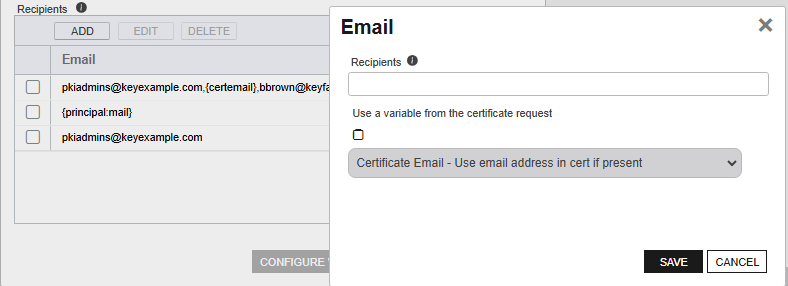
Figure 180: Issued Certificate Alerts Recipients
-
- Click Save to save your issued certificate alert.
Copying an Issued Request Alert
You may use the copy operation to create multiple similar alerts—for example, one to the requester of the certificate and another with a different message to the person responsible for installing it.
- On the Issued Certificate Request Alerts page, highlight the row in the alerts grid and click Copy from the toolbar or right click menu.
- The Issued Certificate Alert Settings dialog will pop-up with the details from the selected alert. The display name field will have - Copy tagged to the end of it to o indicate it is a new alert. You may modify the alert as needed and click Save to add the new alert, or Cancel to cancel the operation.
Deleting an Issued Request Alert
- On the Issued Certificate Request Alerts page, highlight the row in the alerts grid and click Delete from the toolbar or right click menu.
- On the Confirm Operation alert, click OK to confirm or Cancel to cancel the operation.
Configuring an Issued Request Alert Schedule
After adding your desired issued alerts, you may configure a schedule to send the alerts.
- On the Issued Certificate Request Alerts page, click Configure at the top of the Issued Certificate Request Alerts page to configure a monitoring execution schedule. This defines the frequency with which alerts are sent. You can choose to schedule the alerts either for daily delivery at a specified time or at intervals of anywhere from every 1 minute to every 12 hours. A short interval is the most common configuration.
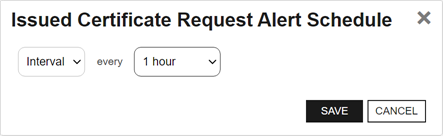
Figure 181: Issued Alert Schedule
Refer to the following table for a complete list of the substitutable special text that can be used to customize alert messages.
Table 20: Substitutable Special Text for Issued Certificate Alerts
|
Variable |
Name |
Description |
|---|---|---|
|
{dnldlink} |
Download Link |
Link pointing to the Certificate Requests page in the Keyfactor Command Management Portal where the certificate requester or the person responsible for installing the certificate can go to download the certificate. The certificate will be available only in a PEM format without the private key unless private key retention has been turned on for the template (see Certificate Templates). |
|
{certemail} |
Email Address in Certificate |
Email address contained in the certificate, if present |
|
{cn} |
Common Name |
Common name contained in the certificate |
|
{dn} |
Distinguished Name |
Distinguished name contained in the certificate |
|
{certnotbefore} |
Issue Date |
Validity date of the certificate |
|
{certnotafter} |
Expiration Date |
Expiration date of the certificate |
|
{issuerDN} |
Issuer DN |
Distinguished name of the certificate’s issuer |
|
{principal:mail} |
Principal’s Email |
Email address retrieved from Active Directory of the user whose UPN is contained in the SAN field of the certificate, if present Note: This substitutable special text token appears in the dropdown only in environments that use Active Directory as the identity provider.
|
|
{principal:givenname} |
Principal’s First Name |
First name retrieved from Active Directory of the user whose UPN is contained in the SAN field of the certificate, if present Note: This substitutable special text token appears in the dropdown only in environments that use Active Directory as the identity provider.
|
|
{principal:sn} |
Principal’s Last Name |
Last name retrieved from Active Directory of the user whose UPN is contained in the SAN field of the certificate, if present Note: This substitutable special text token appears in the dropdown only in environments that use Active Directory as the identity provider.
|
|
{principal:displayname} |
Principal’s Display Name |
Display name retrieved from Active Directory of the user whose UPN is contained in the SAN field of the certificate, if present Note: This substitutable special text token appears in the dropdown only in environments that use Active Directory as the identity provider.
|
|
{requester} |
Requester |
The user account that requested the certificate from the CA, in the form DOMAIN\username for Active Directory users. |
|
{requester:mail} |
Requester’s Email |
Email address retrieved from Active Directory of the user account that requested the certificate from the CA, if present Note: This substitutable special text token appears in the dropdown only in environments that use Active Directory as the identity provider.
|
|
{requester:givenname} |
Requester’s First Name |
First name retrieved from Active Directory of the user account that requested the certificate from the CA, if present Note: This substitutable special text token appears in the dropdown only in environments that use Active Directory as the identity provider.
|
|
{requester:sn} |
Requester’s Last Name |
Last name retrieved from Active Directory of the user account that requested the certificate from the CA, if present Note: This substitutable special text token appears in the dropdown only in environments that use Active Directory as the identity provider.
|
|
{requester:displayname} |
Requester’s Display Name |
Display name retrieved from Active Directory of the user account that requested the certificate from the CA, if present Note: This substitutable special text token appears in the dropdown only in environments that use Active Directory as the identity provider.
|
|
{careqid} |
Issuing CA / Request ID |
A string containing the Issuing CA name and the certificate’s Request ID from the CA |
|
{serial} |
Serial Number |
The serial number of the certificate |
|
{san} |
Subject Alternative Name |
Subject alternative names contained in the certificate |
|
{template} |
Template Name |
Name of the certificate template used to create the certificate |
|
{templateshortname} |
Template Short Name |
Short name (often the name with no spaces) of the certificate template used to create the certificate request |
|
{thumbprint} |
Thumbprint |
The thumbprint (hash) of the certificate |
|
{metadata:Email-Contact} |
Email-Contact |
Example of a custom metadata field |
 ) next to the
 You can also find Help in the Navigator The Navigator is the Keyfactor Command left-hand (newer versions) or top (older versions) navigation menu. Certificate collections and reports can be configured to be added to the menu using user-defined Show in Navigator settings.. From here you can choose to open either the Keyfactor Software & Documentation Portal at the home page or the Keyfactor API Endpoint Utility.
Keyfactor provides two sets of documentation: the On-Premises Documentation Suite and the Managed Services Documentation Suite. Which documentation set is accessed is determined by the Application Settings: On-Prem Documentation setting (see Application Settings: Console Tab).