
When your SSH The SSH (secure shell) protocol provides for secure connections between computers. It provides several options for authentication, including public key, and protects the communications with strong encryption. servers are configured in inventory only mode doing discovery, keys discovered on the servers are considered unmanaged and are displayed on the Unmanaged Keys page.
SSH → Unmanaged Keys
On this page you can review the discovered keys to get a sense of what's out there. You can view the keys, key comments, fingerprint, type, and length. Once you switch your servers to inventory and publish policy mode, deleting a key from the unmanaged keys page will also delete the key from the servers in this mode on which it is found.
As you bring your servers under management, clean up old keys, and control installation of new keys, the number of keys appearing on the unmanaged keys page should begin to diminish. Eventually, the page should be empty when all your servers have been brought under management and all old keys have been replaced with new, managed, keys.
Searching Unmanaged SSH Keys
This page supports the standard query format described in Using Search in the Management Portal and includes its own set of query parsers specific to this operation. Use the following parsers to filter and refine results for this page.
-
DiscoveredDate
The date on which the key was discovered.
-
KeyComments
Complete or partial matches with the user-defined comments on the key.
-
The key size
The key size or key length is the number of bits in a key used by a cryptographic algorithm. of the key. -
Whether the key is:
- RSA A widely used public-key cryptosystem, RSA is commonly used for encryption and digital signatures. It is based on the mathematical difficulty of factoring large integers.
- DSA
- ECC Elliptical curve cryptography (ECC) is a public key encryption technique based on elliptic curve theory that can be used to create faster, smaller, and more efficient cryptographic keys. ECC generates keys through the properties of the elliptic curve equation instead of the traditional method of generation as the product of very large prime numbers.
- Ed448 A high-security elliptic curve algorithm, Ed448 is used for digital signatures and is known for providing very strong security while maintaining high performance. It is part of the Edwards-curve Digital Signature Algorithm (EdDSA) family.
- Ed25519 A member of the EdDSA family, Ed25519 is designed for high security and speed. It is widely used in modern cryptography and provides robust protection with a 256-bit key size.
- ML-DSA-44 A variant of the Digital Signature Algorithm (DSA) designed for high-performance and secure digital signatures. ML-DSA-44 is optimized for specific machine learning use cases or specialized systems.
- ML-DSA-65 Similar to ML-DSA-44, this variant provides a larger key size and is suited for environments requiring more robust security. It is often used in cases where cryptographic strength needs to be balanced with performance.
- ML-DSA-87 An even stronger variant of ML-DSA, offering a larger key size and enhanced security features for demanding cryptographic operations. Like the others in the ML-DSA family, it is designed for specific use cases that require high-performance cryptography.
- SLH-DSA-SHA2-128F
- SLH-DSA-SHA2-128S
- SLH-DSA-SHA2-192F
- SLH-DSA-SHA2-192S
- SLH-DSA-SHA2-256F
- SLH-DSA-SHA2-256S
- SLH-DSA-SHAKE-128F
- SLH-DSA-SHAKE-128S
- SLH-DSA-SHAKE-192F
- SLH-DSA-SHAKE-192S
- SLH-DSA-SHAKE-256F
- SLH-DSA-SHAKE-256S
- RSA
View an Unmanaged SSH Key
To view details for an unmanaged public key In asymmetric cryptography, public keys are used together in a key pair with a private key. The private key is retained by the key's creator while the public key is widely distributed to any user or target needing to interact with the holder of the private key., double-click a key or select the key and choose View from the toolbar or right-click menu.
The view dialog includes two tabs:
- On the Basic tab, you can see information about the key itself, including the key length The key size or key length is the number of bits in a key used by a cryptographic algorithm., fingerprint, comments associated with the key, and the public key itself.
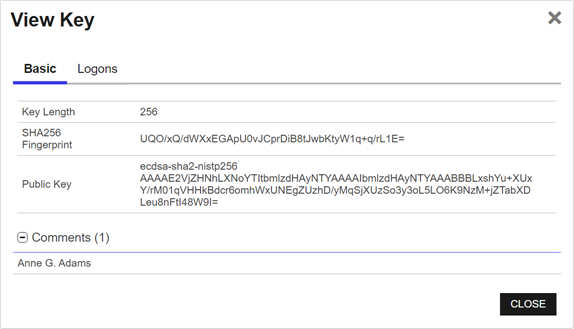
Figure 381: View Basic Tab of an Unmanaged SSH Key
- On the Logon tab, you can view Linux logon names and servers mapped to the public key.
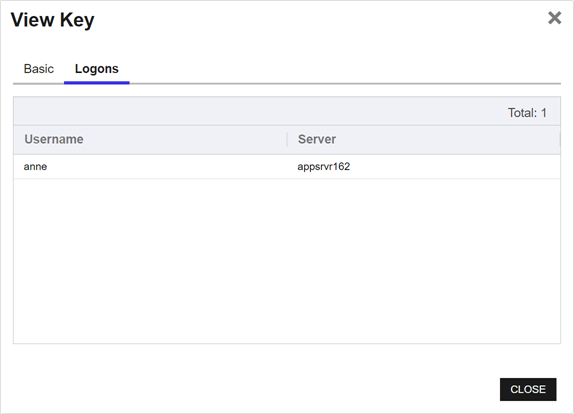
Figure 382: View Logon Tab of an Unmanaged SSH Key
Delete an Unmanaged SSH Key
To delete an unmanaged key, select the key and choose Delete from the toolbar or right-click menu.
 ) next to the
 You can also find Help in the Navigator The Navigator is the Keyfactor Command left-hand (newer versions) or top (older versions) navigation menu. Certificate collections and reports can be configured to be added to the menu using user-defined Show in Navigator settings.. From here you can choose to open either the Keyfactor Software & Documentation Portal at the home page or the Keyfactor API Endpoint Utility.
Keyfactor provides two sets of documentation: the On-Premises Documentation Suite and the Managed Services Documentation Suite. Which documentation set is accessed is determined by the Application Settings: On-Prem Documentation setting (see Application Settings: Console Tab).